
Gemini 4 Argon vs GPT-6 Astra: Which AI Model Is Better?
The AI race is getting more competitive as Google and OpenAI continue to push their most advanced models.
Google’s new Gemini 4 Argon is designed for complex reasoning, coding, long-running tasks, and enterprise workloads. OpenAI’s GPT-6 Astra is also aimed at advanced reasoning and software engineering.
But which model is better?
The answer depends on the type of work you want to do. Recent benchmark results show that Gemini 4 Argon can beat GPT-6 Astra on some tests, while Astra remains ahead on other coding and computer-use benchmarks.
Gemini 4 Argon vs GPT-6 Astra: Quick Comparison
Feature| Gemini 4 Argon| GPT-6 Astra
Developer| Google DeepMind| OpenAI
Context window| Up to 1 million tokens| Up to 1 million tokens
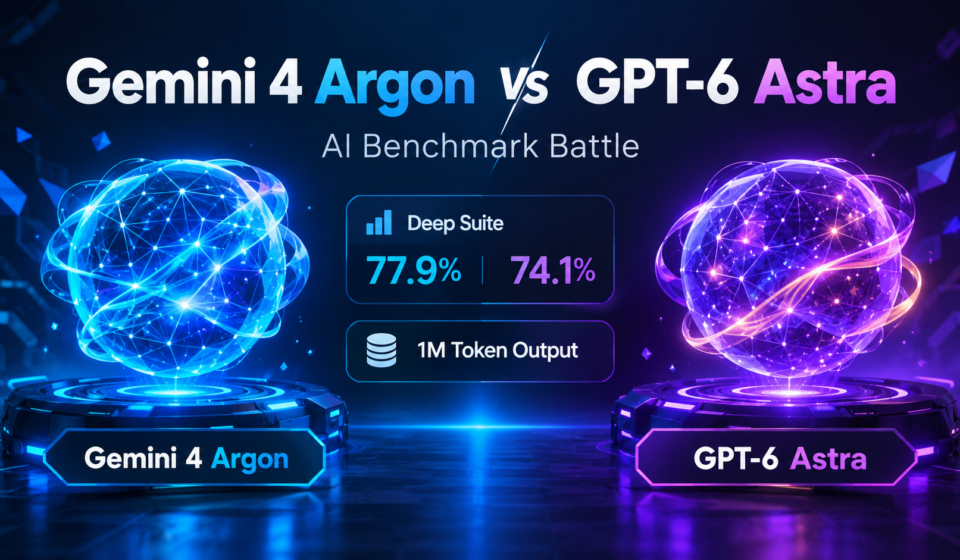
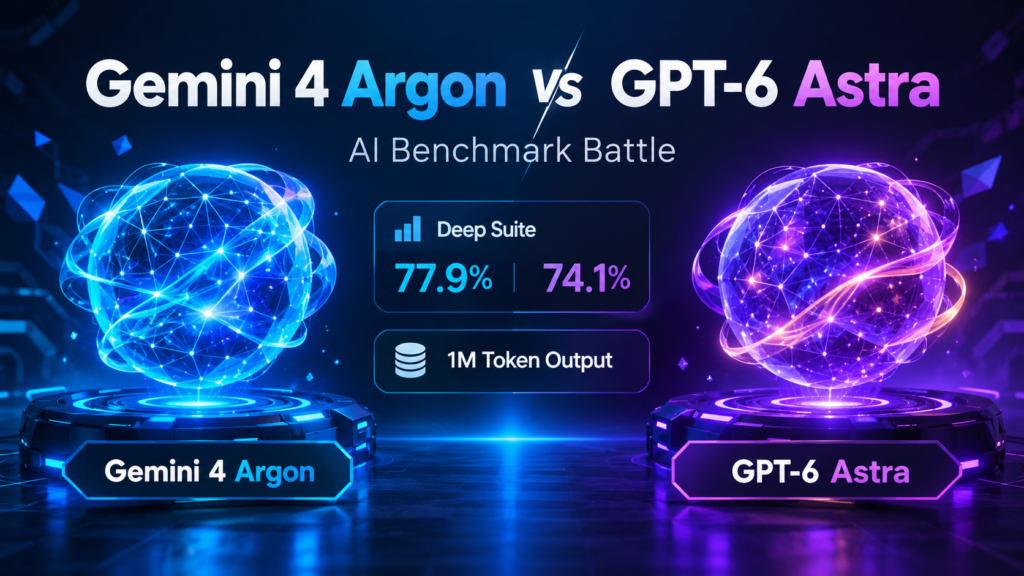
Deep Suite V1.1| 77.9%| 74.1%
Reasoning| Very strong| Very strong
Coding| Strong| Strong
Multimodal input| Yes| Yes
Current availability| Limited access| Available
Main strength| Long, complex tasks| Coding and advanced workflows
Benchmark results can vary depending on the test, so these numbers should not be treated as proof that one model is always better than the other.
Gemini 4 Argon Shows Strong Benchmark Results
One of Gemini 4 Argon’s biggest advantages is its performance on complex, multi-step tasks.
According to the benchmark comparison reported by Geeky Gadgets, Argon scored 77.9% on Deep Suite V1.1, compared with 74.1% for GPT-6 Astra. Anthropic’s Fable 5.1 scored 67.4% in the same comparison.
This suggests that Argon can be particularly strong when a task requires several reasoning steps instead of a simple question-and-answer response.
However, Argon does not lead every benchmark.
Independent testing shows Astra ahead on some software engineering and computer-use evaluations, while Argon performs better on several other reasoning and automation tests.
Gemini 4 Argon Is Built for Long Tasks
Another major feature of Gemini 4 Argon is its ability to generate up to 1 million output tokens.
That is a huge amount of text and code in a single response. It could be useful for large software projects, long technical analysis, large documents, and other tasks that require many steps.
For developers, this could make Argon especially interesting for working with large codebases or long-running coding projects.
However, producing large amounts of output can also increase costs, so the maximum token capacity does not automatically make it the best option for every user.
GPT-6 Astra Still Has Important Advantages
While Gemini 4 Argon performs extremely well in several tests, GPT-6 Astra should not be ignored.
Independent benchmark data shows Astra performing better on some software engineering and computer-use tests. For example, Astra scores higher on Terminal-Bench 4.0 in the comparison, while Argon performs better on tests such as AutomationBench and SciCode.
This means developers should choose a model based on their actual workload instead of simply choosing the model with the highest score on one benchmark.
Gemini 4 Argon Pricing
Cost is another important difference.
The reported introductory pricing for Gemini 4 Argon starts at around $2 per million input tokens and $10 per million output tokens. Standard pricing is reported at $4 per million input tokens and $20 per million output tokens.
Independent Artificial Analysis data currently lists GPT-6 Astra at a higher token price than Argon, although actual costs depend on usage and the specific service being used.
For companies running large AI workloads, this difference could become important.
Gemini 4 Argon Is Not Widely Available Yet
There is one major limitation with Gemini 4 Argon: availability.
Google is currently providing Argon to selected cybersecurity partners and other early testers. A specific date for a full public release has not been announced.
This gives GPT-6 Astra an important practical advantage for users who want to start using a powerful model immediately.
For now, Argon’s benchmark performance is interesting, but most users may have to wait before they can test it themselves.
Which AI Model Is Better?
There is no simple winner.
Gemini 4 Argon may be the better choice for:
– Long and complex reasoning tasks
– Large-scale coding projects
– Long-form content generation
– Automation workflows
– Tasks requiring a very large output
– Cost-sensitive API workloads
GPT-6 Astra may be the better choice for:
– Advanced software engineering
– Computer-use tasks
– Certain coding benchmarks
– Users who need a model that is already broadly available
The best choice ultimately depends on the work you need the AI to perform.
Gemini 4 Argon vs GPT-6 Astra: Final Verdict
Gemini 4 Argon is shaping up to be a serious competitor to GPT-6 Astra.
Its 1 million-token output capacity, strong reasoning performance, and lower reported API costs make it particularly interesting for developers and businesses handling large AI workloads.
However, GPT-6 Astra still performs better on some important coding and computer-use benchmarks.
For now, the most accurate conclusion is that neither model is the clear winner in every category. Argon looks especially promising for long-running and reasoning-heavy workloads, while Astra remains a strong option for software engineering and other advanced tasks.
The real test will come when Gemini 4 Argon becomes widely available and developers can compare both models on their own projects.