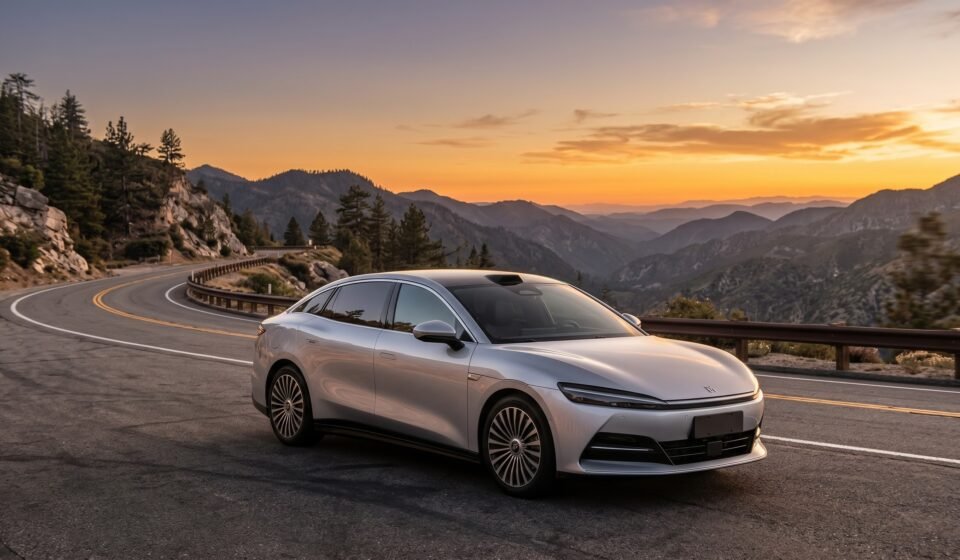

BYD is preparing a fresh update to its popular sedan lineup. The company’s all-new Han and third-generation Qin Plus have appeared in China’s latest vehicle regulatory filings, revealing important details about their size and powertrains.
The new models show how BYD is continuing to expand its electric vehicle range. The larger Han is set to offer powerful electric versions alongside a plug-in hybrid option, while the new Qin Plus EV targets drivers looking for a more practical electric sedan.
These updates arrive as BYD works to strengthen its position in China’s increasingly competitive car market.
1. The New BYD Han Is Bigger Than Before
The all-new BYD Han is one of the most notable vehicles in the latest filings. It measures 5,156 mm in length and 1,969 mm in width, with a wheelbase of 3,030 mm.
Compared with the Han EV Flash Charging Edition introduced in April 2026, the new model is 161 mm longer and 59 mm wider. Its wheelbase has also increased by 110 mm.
These larger dimensions could help provide a more spacious cabin, especially for rear passengers. They also give the Han a stronger presence in the premium electric sedan segment.
The filings list three fully electric variants and one plug-in hybrid version. All four versions are designed to seat five people.
BYD has not yet confirmed all the retail details, including the final prices and complete equipment specifications.
2. BYD Han EV Could Deliver Up to 520 kW
The electric versions of the new Han offer different motor configurations for drivers with different performance needs.
The two rear-wheel-drive models feature single electric motors producing 245 kW and 300 kW. Both have a listed top speed of 240 km/h.
The most powerful electric version uses a dual-motor all-wheel-drive setup. It combines a 200 kW front motor with a 320 kW rear motor, delivering a total peak output of 520 kW.
This version has a listed top speed of 270 km/h, making it the performance-focused option in the lineup.
BYD is also preparing a plug-in hybrid version. It pairs a 1.5-liter engine with an electric motor rated at 200 kW of peak power. Its listed top speed is 200 km/h.
Battery capacity, driving range, charging performance, and final prices have not been fully disclosed in these filings.
3. Third-Generation BYD Qin Plus EV Gets Larger Dimensions
The third-generation BYD Qin Plus EV has also appeared in China’s regulatory database.
The electric sedan measures 4,840 mm long, 1,900 mm wide, and 1,498 mm tall. Its wheelbase reaches 2,800 mm.
The new dimensions suggest BYD is focusing on interior space and everyday practicality. A longer wheelbase can create more room between the front and rear wheels, potentially improving passenger comfort.
The filing lists a permanent-magnet synchronous electric motor with a peak output of 100 kW. The car uses a lithium iron phosphate battery and has a listed top speed of 170 km/h.
However, the filing does not confirm the battery’s capacity or the car’s official driving range. Buyers will need to wait for further details to understand how far the new Qin Plus EV can travel on a full charge.
4. Electric and Plug-In Hybrid Versions Need to Be Distinguished
BYD’s Qin family includes both battery-electric and plug-in hybrid vehicles, so it is important to separate the available information about each version.
The regulatory filing discussed here covers the third-generation Qin Plus EV, which runs entirely on electricity.
Meanwhile, Lu Tian, general manager of sales for BYD’s Dynasty lineup, teased the next-generation Qin Plus on Chinese social media. The images accompanying his post showed the Qin Plus DM-i plug-in hybrid version.
This suggests that BYD is also promoting the hybrid model, but the specifications shown in the EV filing should not automatically be applied to the DM-i.
The Qin family has already received several updates in 2026. BYD introduced longer-electric-range versions of the Qin Plus DM-i and Qin L DM-i in January, then launched the Qin Max in August.
The next-generation Qin Plus could further strengthen this lineup by giving buyers another option in the competitive affordable sedan market.
5. Why These New BYD Sedans Matter
The updates arrive at an important time for BYD’s sedan business.
According to sales figures reported by CnEVPost, the Han series sold 2,529 units in September 2026. That represented a 70.9% decline compared with the same month last year.
Between January and September, Han series sales reached 44,324 units, down 68.86% year over year.
These figures highlight the pressure on BYD to refresh its established models and attract buyers with updated designs, improved specifications, and more choices.
The new Han could appeal to customers who want a large electric sedan with stronger performance options. The third-generation Qin Plus EV, meanwhile, could attract buyers who prioritize everyday transportation and a practical electric powertrain.
Both vehicles also reflect the growing competition among Chinese automakers, which are expanding their electric lineups and introducing new models at a rapid pace.
Conclusion
BYD’s all-new Han and third-generation Qin Plus EV represent important updates to two established sedan families.
The new Han stands out with its larger body and a dual-motor electric version producing 520 kW. The Qin Plus EV focuses on practical dimensions, a 100 kW electric motor, and an LFP battery.
Although key details such as pricing, battery capacity, and driving range remain unconfirmed, the regulatory filings provide an early look at what buyers can expect.
BYD’s next challenge will be turning these updated specifications into strong sales. Official launch details should help determine how competitive the new sedans will be in China’s fast-moving electric vehicle market.